If you’ve ever sat in a theater waiting for a ballet to begin, you know that first moment when the house lights dim, and the curtain rises: that split second sets the tone for the entire performance. For ballet, in particular, the curtain isn’t just a barrier between audience and stage—it’s a tool that supports storytelling, protects the dancers, and can make technical runs run smoothly. As someone who’s worked with stage curtains for over a decade, I’ve seen firsthand how many production teams overlook the small details that turn a good curtain setup into a great one. This guide is built on the conversations I’ve had with ballet directors, technical managers, and costume designers around the world; it’s not just a list of specs, but what actually works for a ballet’s unique needs. Stage Curtains
Start With the Core: Function, Not Aesthetics First
Ballet has very different needs than, say, a rock concert or a community theater play. Where a concert might use a curtain that’s quick to take down and set up for scene changes, ballet relies on long, consistent performances with multiple acts, delicate movement, and live music. The first question to ask isn’t “what color looks pretty?” but “what does this curtain need to do for the dancers and the show?”
The most basic function of any stage curtain is opacity. If you’re performing a ballet that uses projections—whether it’s a backdrop for a snowy forest in The Nutcracker or a castle wall in Swan Lake—you need a curtain that blocks 100% of stray light. Even a thin amount of light seeping through a cheap, sheer fabric can ruin the clarity of a projection, or make backdrops look faded. For ballets that don’t use projections, opacity still matters: if you’re doing a quick scene change between acts, you don’t want the audience to peek through gaps in the fabric while dancers move sets backstage. I’ve had clients tell me they saved a few hundred dollars on a “lightweight” curtain only to find half their act two choreography was visible through the fabric from the front row.
Next, consider how the curtain moves. Ballet has two types of main curtains: the grand drape (the one that opens for the start and end of the show) and act curtains (the ones that separate scenes between acts). Grand drapes need to be durable—they open and close thousands of times a year, and they have to hold their shape even when pulled tight across a large stage. Act curtains, on the other hand, need to move faster, but still have that “lift” when they part that makes the audience gasp. I always recommend flame-retardant fabric as a base, too: most theaters require this by code, but ballet companies often perform in older venues that don’t have advanced fire suppression, so a NFPA 701-certified fabric non-negotiable here.
Fabric Choices That Balance Movement, Visibility, and Longevity
Once you know the functions your curtain needs to serve, the fabric is where you make the right call. Not all stage fabrics are created equal, and for ballet, there are a few standouts that I see again and again for good reason.
The classic choice for grand drapes and act curtains is velvet. Heavy velvet has a natural drape that looks luxurious under stage lights, and it’s thick enough to block almost all light, which is perfect for scene changes. But not all velvet is the same. Cheap polyester velvet looks great new, but after a few dozen opens and closes, it develops fuzz on the edges, which makes it look worn and can catch on the curtain track. I recommend a woven cotton-blend velvet for ballet: it’s heavier, so it holds its shape longer, and it resists fuzzing much better than pure polyester. The weight is also important—for a stage that’s 40 feet wide or larger, you need a velvet that’s at least 16 ounces per square yard; lighter velvet will stretch over time, leaving gaps at the bottom when it’s closed.
For backdrop curtains, which are sometimes used in ballets to set scene locations, the choice is different. If you’re using projections, a blackout fabric is a must. I sell a poly-cotton blend blackout fabric that’s coated on the back to completely block light, and it’s much lighter than velvet, so it’s easy to hang and adjust. But if you’re not using projections, a smooth, matte fabric in a neutral color (usually deep blue or forest green for ballet) works best. Glossy fabrics reflect stage lights, which can make dance costumes look washed out from the audience’s view; matte fabric absorbs light, so the colors of the costumes, makeup, and sets stay true.
Another often-overlooked fabric detail is noise. Ballet dancers move very quietly—pointes shoes make almost no sound on a well-maintained stage—so a curtain that rustles when it moves can distract from the performance. Heavy velvet is naturally quieter than satin or polyester, which have a crinkly texture. I once had a professional ballet company switch from a satin act curtain to velvet because the satin would make a loud crack when it parted, and they’d had multiple audience members comment that it pulled them out of the story mid-performance.
Size and Fit: Don’t Guess, Measure
This is the part that trips up even experienced production teams. I’ve had clients come to me saying “we need a curtain for a 50-foot stage,” only to find out they measured the wrong part of the stage, or didn’t account for how much the curtain has to extend beyond the opening to hang properly.
For a grand drape, you need to measure three things: the width of the stage opening (from wall to wall), the height of the opening (from the stage floor to the proscenium arch), and the “stackback” space—how much room is behind the curtain track when it’s pulled open. If the stackback is less than 3 feet, a standard velvet curtain will bunch up too much when it’s open, leaving unsightly folds at the top. For smaller theaters (under 30 feet wide), a 12-ounce velvet works, but for larger venues, you’ll need a heavier 16 or 18 ounce fabric to avoid bunching.
For act curtains, the rule is similar, but you also need to account for how far the curtain will drop. If your act curtain is a “ripplefold” style (the most popular for ballet, since it creates smooth, even folds when opening and closing), you need to add 10% to the total width of the stage opening to get the right fit. A lot of people forget that extra 10%, and end up with a curtain that’s too narrow, leaving gaps on either side when it closes.
Also, don’t forget the bottom of the curtain. For ballet, you don’t want the curtain dragging on the stage floor, but you also don’t want a gap between the curtain and the floor where light can seep through. The best height is about 1 inch above the stage floor—just enough to avoid catching on dance shoes, but low enough that no light comes through from backstage.
Color: What Works for Ballet, and What Doesn’t
Color is where you get to add personality, but it’s still tied to function. Ballet is almost always performed in neutral or dark colors, but there’s a reason for that.
Black is the most common color for grand drapes and act curtains. It’s versatile, it blocks all light, and it goes with every ballet production, no matter the theme. If you’re doing a production like The Nutcracker, which has bright, colorful sets, a black curtain makes those sets stand out. If you’re doing a more dramatic ballet like Giselle, a dark gray or deep burgundy can add a moodier tone without being too bold. I once worked with a small regional ballet company that wanted a light blue curtain for their spring production of A Midsummer Night’s Dream; it looked beautiful, but after a few performances, it started to pick up scuffs from dancers moving sets, and it showed way more dust than a dark color. For ballets that need a subtle pop of color, opt for a muted tone—like forest green or navy—instead of bright red or purple, which can distract from the dancers’ movements.
Another thing to consider: colorfastness. Stage lights get very hot, and they can cause fabric to fade over time. A cheap, dyed velvet will fade after a few hundred hours of being under stage lights, so you’ll have to re-dye or replace the curtain much sooner. I only use solution-dyed fabric for ballet curtains; the color is part of the fiber itself, so it won’t fade even after years of use. I had a client who used a cheap dyed curtain for their Swan Lake production—by the end of the run, the black curtain was a dull gray, and it looked like it was in disrepair. A solution-dyed curtain would have stayed black the entire run.
Extras That Make a Ballet Curtain Work
Once you’ve got the base fabric and size, there are a few small additions that can make a huge difference for a ballet performance.
First, curtain tracks. For ballet, a ripplefold track is the best choice, since it creates smooth, even folds that look elegant when the curtain opens. A lot of older tracks have gaps that cause the curtain to pull unevenly, which can leave a gap in the middle when it’s closed. I always recommend a heavy-duty aluminum track, which is durable and creates tight, even folds.
Another addition is a blackout liner, even if you already have a dark curtain. If your ballet uses projections, a liner blocks any stray light from the backstage side, so the projection is crystal clear. Liners also add extra weight to the curtain, which makes it hang straighter and look more polished.
Finally, think about easy cleaning. Ballet performances can be messy—costumes shed glitter, dancers spill water backstage, and dust builds up quickly. A velvet curtain is easy to spot-clean, but make sure it’s machine-washable (or at least dry-cleanable) so you don’t have to replace it after a few runs. I never sell curtains that aren’t easy to maintain, because I’ve seen too many companies with curtains that get stained and look unprofessional mid-run.
Final Thought: It’s About the Performance, Not the Curtain
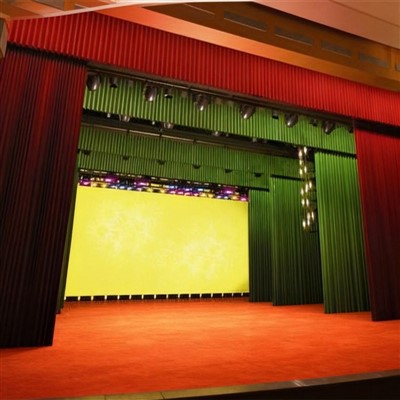
At the end of the day, the best stage curtain for a ballet is one that doesn’t take away from the dancers or the story. It’s there to create that first moment of anticipation, to separate scenes so the audience is fully focused on the act on stage, and to keep the show running smoothly for every performance. If you’re planning a ballet production and need help picking the right curtain—whether it’s for a small community theater or a large professional company, we’re here to walk through your space, your needs, and your budget to find the perfect fit. Reach out to our team today to discuss your requirements and plan for a curtain that works for your ballet.
References
Stage Curtains Stage Managers Association. (2021). Stage Curtain Specifications for Live Performance. International Association of Venue Managers. (2022). Fabric Selection Guidelines for Theatrical Curtains. National Fire Protection Association. (2020). NFPA 701: Standard Methods of Fire Test for Flammability of Fabrics and Films Used in Theatrical Applications.
JIANGSU HONGBO STAGE EQUIPMENT SCIENCE AND TECHNOLOGY CO., LTD.
As one of the most professional stage curtains manufacturers and suppliers in China, we’re featured by quality products and good price. Please rest assured to wholesale bulk advanced stage curtains for sale here and get quotation from our factory. Customized orders are welcome.
Address: Dasi Industrial Park, Gaogang District, Taizhou City, Jiangsu Province
E-mail: hongbowutai@gmail.com
WebSite: https://www.hbstageequipment.com/
