
Multi-pitch means an early start
Multi-pitch climbs are often associated with trad climbing but in Britain and abroad there are mult-pitch sport climbs too.The beauty of multi-pitch climbing is that you become involved in the adventure of the climb, and as you gain height the feeling of affinity with the rock becomes overwhelming.
And, as you get deeper into the climb, you look ahead and wonder if you can complete it and doubts begin to creep in. A multi-pitch climb can take anything from 4 hours to 4 days 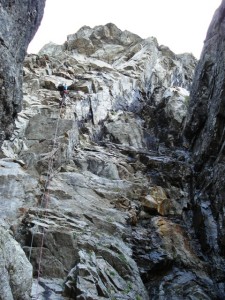 plus depending on the climb you choose. You feel committed and often cannot anticipate problems or the level of difficulties, even when you have a guidebook for the route. And then there’s the descent. Will you be able to find the abseil points and/ or the descent path? Will you get benighted and have to do it in the dark? Will the ropes get tangled or caught in a crack? Will the path be obvious?
To succeed on mult-pitch climbs your rope work must be meticulous. Care and time must be taken to make sure everything is right. You don’t need to be fast, even though you have a long way to go, but you need to be methodical. You shouldn’t feel rushed, as this is when mistakes are made, so plan ahead, begin the climb early and enjoy the process. Good route finding is a time saver. Going off route costs time and may lead you into trouble. Taking a copy of the route guide with you is imperative.
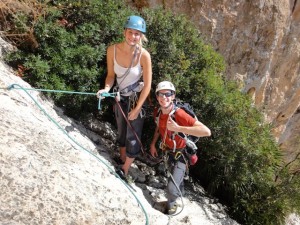
Keeping safe – clove hitched to the belay
The best way to enjoy multi-pitch is to share and alternate the leading.This means that at the belay stance the leader brings up the second who strips the gear as he ascends and then once he is at the stance, the rope is already on the top, ready for the second to take over as the lead climber. Both climbers must make themselves safe on the belay before any exchange or rearrangement of gear and the belayer may have to turn the belay plate round depending on the line of the next pitch.
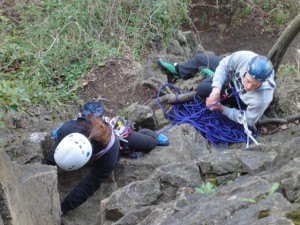
Alternating the lead – meticulous rope work
Arriving at the belay, the leader often has to construct a belay from spikes, threads, nuts and cams, and, if possible he must position himself so that he can see the ascending second. Sometimes, if the route traverses round a corner or surmounts an overhang, this is not possible and it is essential that the belayer and climber communicate clearly with each other. This is where climbing calls are crucial, although if you are climbing above the sea, or a busy road it is often quite difficult to hear one another. The leader ties into the belay via a screw gate karabiner and a clove hitch. If the belay is further from the edge, the leader can either clip into the belay and move to the edge and make himself safe by tying a clove hitch to a screw gate karabiner attached to the rope loop, or by tying a figure of 8 on a bight through the rope loop.
Often on multi-pitch climbs there are no stances to belay from and you have to take a hanging belay. If this is the case the rope has to be lap coiled over the feet or at the waist, where the rope attaches the climber to the belay. The rope is lapped from longer to shorter coils so they feed off smoothly for the lead climber and this system helps to avoid snags if the wind picks up. If the rope is left dangling down the rock face, it can be easily caught on rocks and vegetation and is much harder to pay out as you are pulling up the full weight of the rope.
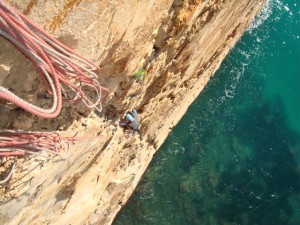
Rope coils on a hanging stance
If just one climber leads all the pitches, then at every stance the rope must be turned over/flaked/pulled through into a neat pile to ensure the leaders’ rope is on top and there is little likelihood of a tangled rope which could impede the leaders’ progress and even pull him off.
Before you climb you have to anticipate how long the climb will take you, based on your own climbing ability, the description of the route and the weather forecast. For multi-pitch climbs that may take several days you need a window of good weather if you are to be successful. You have to take responsibility for your ascent and limit as much as possible potential risks. How much food and water will you take and spare clothing? Do you need bivvy gear? What about hardware; do you take the bare minimum or everything you own, just in case? It is a fine line as to whether you take too much or too little and you won’t always get it right. In the Alps, for instance, you may get hit by an unpredicted storm in the summer, which brings snow and sub zero temperatures. This has led to many deaths. Multi-pitch climbing is no riskier than single pitch climbing, but because of the time and height involved it can lead to severe fatigue which in turn leads to mistakes especially at the end of a long day when the light begins to fade.
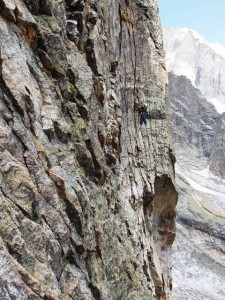
New routing in the Italian Alps
Obviously if you are contemplating progressing to multi-pitch climbing, start small and do climbs within your grade that you know are easy to escape from. And, if in doubt, employ a Mountain Instructor or Guide to teach you. But the best thing about multi-pitch climbing is that it can take you to the most beautiful, remote and unspoilt areas of the World that will blow your mind.