If you’ve ever ordered a molded part for medical devices, automotive lighting, or optical displays, you know transparency isn’t just a cosmetic feature—it’s make-or-break for performance. As a molded parts supplier with 12 years on the floor, I’ve seen first-hand how a part that passes a visual inspection today can fog or crack six months down the line because a small, often overlooked detail slipped through production. Transparency in molded parts isn’t a single trait; it’s a balance of material science, process control, tooling precision, and even environmental conditions before the part leaves your facility. Let’s break down the factors that shape this critical quality metric, and what we do at our shop to nail it every time. Molded Part
First up, material selection. This isn’t just picking any clear plastic off a shelf. I’ve worked with every major clear resin under the sun—polycarbonate (PC), acrylic (PMMA), SAN, even specialty cyclic olefin copolymers (COC)—and each has unique quirks that impact transparency right out of the bag. For example, PC is prized for impact resistance, but it’s prone to internal stress if processed wrong, which causes tiny micro-cracks that scatter light and turn a clear part hazy. Acrylic, on the other hand, has excellent inherent clarity, but it absorbs moisture quickly. If you don’t dry acrylic properly before molding, those water molecules turn into tiny vapor bubbles during the melt phase—think of it like boiling water in a pot with a lid on; the bubbles pop, but leave little craters that distort light. I learned this the hard way early on when a client’s acrylic lens parts came back with 30% scrap because we skipped a 4-hour drying cycle for the resin. We now test every resin lot for moisture content with a portable moisture analyzer before it even touches the hopper—small step, huge difference.
Additives are another material wild card. Molding compounds often come with additives for UV resistance, flame retardancy, or mold release, but too much of a good thing can ruin transparency. We once had a client ask for a clear PC part for an outdoor electronic enclosure that included a flame retardant. Our first trial batch had a beautiful finish, but when we tested light transmission, it was 15% lower than spec. Turns out the flame retardant they picked was a pigmented additive that dispersed unevenly, creating tiny particles that scattered light. We switched to a specialized clear flame retardant additive that dispersed uniformly, and hit the exact light transmission number the client needed. Mold release agents are even trickier—external spray releases can leave a thin, hazy layer on the part surface, so we only use internal mold releases that mix into the resin during compounding, and we adjust the concentration every month as we get new resin batches.
Next, process parameters. Molding is a dance of temperature, pressure, and time, and missteps here directly kill transparency. Let’s start with melt temperature: if the resin is too cold, it won’t melt evenly, leaving un-melted polymer pellets that act as tiny light-scattering specks. If it’s too hot, the resin can degrade, forming yellowing or bubbles. Our PC melt temperature hovers around 550°F, but we calibrate our injection molder’s barrel temperature every single morning before production—even a 10°F drop overnight can lead to scrap. Then there’s injection pressure and speed. If you inject the resin too fast, it shears too much, creating internal stress lines that look like faint streaks in the part. Too slow, and the resin cools before it fills the mold, leading to incomplete parts or voids that scatter light. We use pressure sensors on every mold cavity that adjust injection speed in real-time if they detect uneven flow—no more guessing how fast to push the resin.
Cooling is the most underrated step for transparency, in my opinion. When the hot resin hits the cool mold, it cools at different rates depending on where it’s touching the mold surface. The surface cools fast, forming a tight, crystalline structure? Wait, no—amorphous resins like PC and PMMA cool to an amorphous (non-crystalline) state, which is clear, but if they cool unevenly, the internal molecular structure is misaligned, causing stress birefringence, which is a fancy way of saying the part scatters light because the molecules aren’t lined up right. We use temperature-controlled mold plates that maintain a consistent ±2°F across the entire mold surface, not just the core or cavity. For thick parts, we also use sequential cooling: cool the edges first, then the center, so the part cools evenly. Last year, we had a client with a ½-inch thick acrylic lens that kept coming out cloudy in the center. After switching to our sequential cooling system, the center light transmission jumped 20%—fixed a problem we’d been troubleshooting for three months.
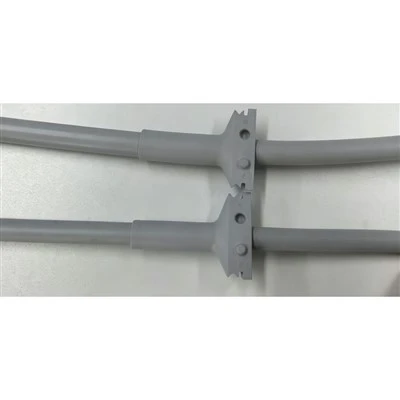
Tooling design is the third big factor, and it starts before the mold is even built. The gate, the part where the resin enters the mold, is a common culprit for transparency issues. A gate that’s too small causes excessive shear stress as the resin flows through, creating stress lines near the gate. A gate that’s placed in a thick section of the part can trap air, leading to voids. Early in my career, we built a mold for a automotive PC headlight lens with a gate on the edge of the lens, and every part had a faint, hazy line right at the gate. We re-designed the gate to a fan gate that spreads the resin flow across the edge of the lens, reducing shear, and that line disappeared completely. Venting is another tooling detail: if air gets trapped in the mold as the resin fills, it creates bubbles and surface imperfections that ruin clarity. We add tiny vent grooves (just 0.001 inches deep) at the end of every resin flow path, so air escapes easily. Even mold surface finish matters: a polished cavity gives a smooth part surface that doesn’t scatter light, while a rough surface creates micro-irregularities that make the part look foggy. We use a 1200-grit polish for all clear part molds, and we inspect every cavity under a microscope every time we change a mold to make sure there’s no scratches or nicks.
Wait, I should also mention post-molding handling and processing, because transparency doesn’t stop when the part comes out of the mold. Thermal stress from post-molding steps like annealing is a big one. Annealing is heating the part just below its glass transition temperature to relieve internal stress, which prevents cracking and haze over time. For PC parts, we anneal at 280°F for two hours, because if we skip that, the part can develop micro-cracks from temperature changes during assembly or use—we’ve had clients send parts back that looked clear right after molding but turned hazy after being installed in a car door that heats up to 180°F in the sun. Surface finishing also matters: if you need to paint or coat a clear part, the coating has to be matched to the resin’s refractive index. If the coating’s refractive index is too different from the part, light will bounce at the surface, causing haze. We work with our coating suppliers to match every clear resin’s refractive index, so even after coating, the part stays 98% of its original light transmission.
Environmental factors before delivery are another thing we’ve had to address. We once shipped a batch of acrylic parts in a humid climate, and when the client unboxed them, half were foggy. Turns out the parts had absorbed moisture from the air during shipping, even though they were dry when they left our facility. Now we package all clear parts in moisture-barrier bags with desiccants, and we put a humidity indicator card in every box so the client can verify the parts stayed dry during transit. We also avoid storing clear parts near harsh chemicals, because solvents can etch the surface and create haze—we keep our clear parts in climate-controlled storage, separate from parts molded with resins that release volatile compounds.
At the end of the day, transparency in molded parts is a combination of small, consistent details, not one big magic fix. It’s not just about running the right machine or buying the best resin—it’s about checking moisture levels every morning, calibrating mold temperatures hourly, inspecting every cavity for scratches, and testing every batch for light transmission and stress levels. If you’re a design engineer or procurement manager working on a project that requires a clear molded part, you don’t have to guess which supplier will get this right. We’ve spent years refining every step of our process to deliver parts that meet strict transparency specs, whether you need 92% light transmission for a medical syringe window, 85% for an automotive taillight lens, or custom optical clarity for a display component.
If you’re tired of dealing with parts that are “clear enough” but fall short when it counts, let’s connect. We can work with your design team to adjust material choices, process parameters, or tooling to get the exact transparency level you need, and we provide full test reports for every batch to back up our quality. Reach out to our team to discuss your project specs, and let’s make sure your molded parts are transparent, durable, and reliable for every application.
Molded Part References
- Rosato, D. V., & Rosato, M. G. (2000). Injection Molding Handbook (3rd ed.). Springer.
- Harper, C. A. (2002). Modern Plastics Handbook (4th ed.). McGraw-Hill.
- Crawford, R. J. (1998). Plastics Engineering (2nd ed.). Butterworth-Heinemann.
- Throne, J. L. (2007). Understanding Molded Part Quality. Hanser Gardner Publications.
BESTYIELD Technology (Huizhou) Co., Ltd.
BESTYIELD Technology (Huizhou) Co., Ltd. is one of the most professional molded part manufacturers and suppliers in China, featured by quality products and good price. Please rest assured to buy durable molded part made in China here and get quotation from our factory. Customized orders are welcome.
Address: Yinshan Industrial Zone, Liangjing Town, Huiyang District, Huizhou City, Guangdong Province
E-mail: rick@bestyield.net
WebSite: https://www.bestyield.org/
